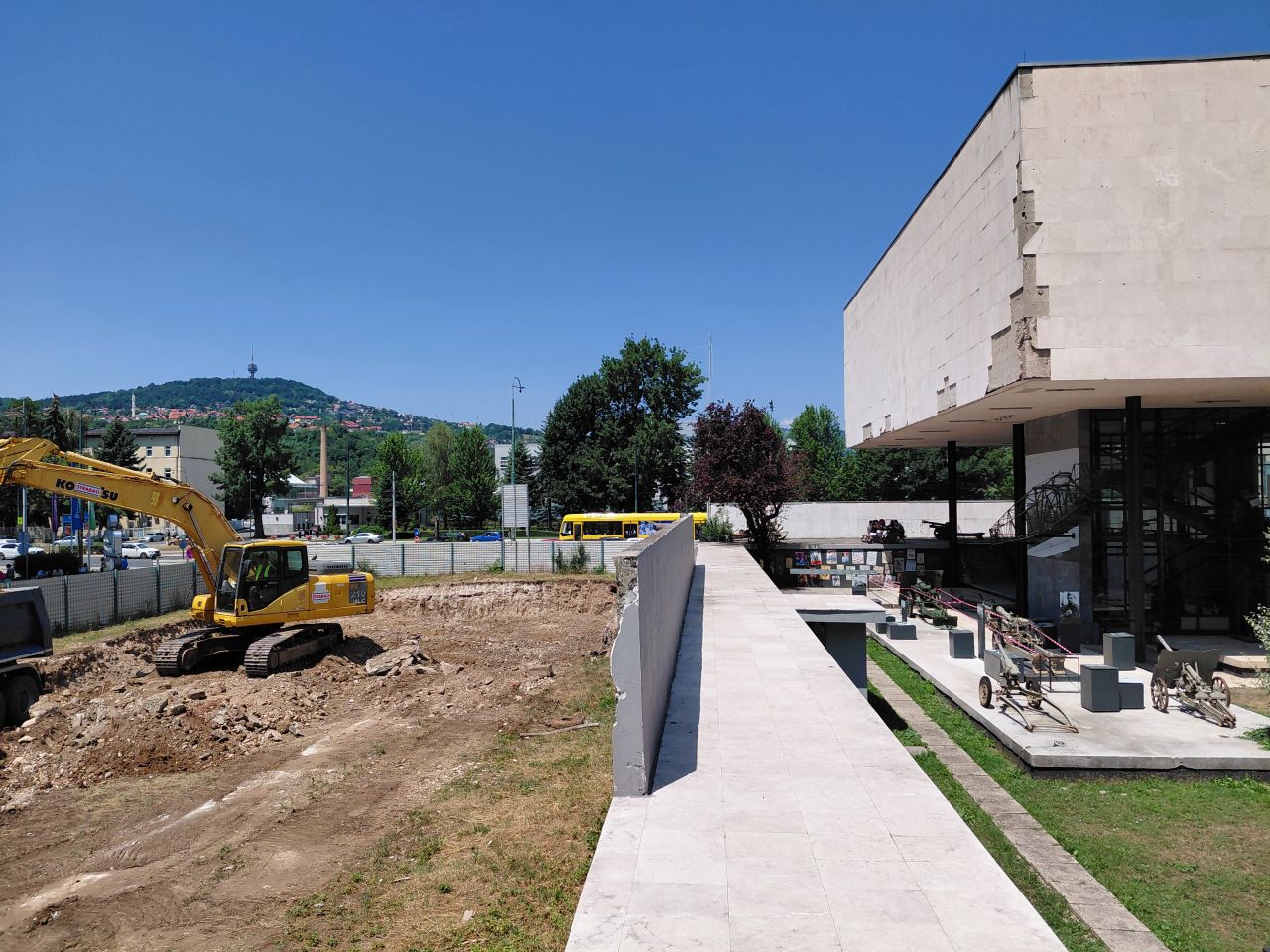
The construction of the long-awaited Ars Aevi Museum of Contemporary Art is an important milestone for Sarajevo. We warmly welcome this project, coordinated by UNESCO and supported by the European Union, the governments of Italy, France and Spain, and the Canton of Sarajevo. Bringing together an exceptional collection—born from the solidarity of artists worldwide with besieged Sarajevo—and based on the vision and original architectural design of Renzo Piano, who supported the project from the beginning, Ars Aevi will become an important addition to Sarajevo's museum district in Marijin Dvor.
However, the realization of one museum must not come at the expense of another. Standing immediately next to the future Ars Aevi building, the History Museum of Bosnia and Herzegovina is an irreplaceable institution whose internationally acclaimed modernist building, designed by Boris Magaš, Radovan Horvat and Edo Šmidihen and built in the 1960s, has been a National Monument of Bosnia and Herzegovina since 2012.
The building suffered severe damage during the siege of Sarajevo and, because of the unresolved legal status of the Museum and the absence of structural funding for more than three decades, it remains in poor condition. In the most visible way, this is illustrated by the damaged facade of the building's emblematic centrepiece, the cubus.
Nevertheless, different restoration efforts have been undertaken in the last 15 years by the museum team which succeeded in securing funding for important repairs—including the roof and administrative section. Together with partners, it also prepared a comprehensive conservation and restoration project for the building, with the total costs estimated at at least 9.5 million KM (approximately €4.9 million) in 2022. In 2024, the Canton of Sarajevo allocated the amount of 1,8 million KM (approximately €920,000) for restoration of the parts hosting the main museum collections. However this funding has not been implemented yet and will in any case not cover the totality of the needed restoration.
Besides raising funding for restoration of the building, the museum team is doing remarkable work to fill the History Museum of Bosnia and Herzegovina with life and has succeeded to make it an innovative, inclusive and constructive cultural space which has earned well-deserved respect by local and international partners.
In this context, we deeply regret that the local and international stakeholders supporting Ars Aevi have not at the same time committed themselves to ensuring adequate funding for the restoration of the History Museum of Bosnia and Herzegovina which would guarantee the simultaneous development of both buildings.
We regret even more that construction of the Ars Aevi Museum, in the immediate vicinity of the History Museum, began without any communicated risk assessment regarding its possible impact on the neighbouring protected monument and without visible preventive measures to safeguard the building of the History Museum, its staff and its visitors.
We therefore fully support the request submitted by the History Museum of Bosnia and Herzegovina to the competent authorities on 15 July 2026, underlining the urgency of the situation and the need for immediate and effective protective measures. (See: muzej.ba/en/request-for-the-adoption-of-urgent-mea... )
These concerns proved well-founded when, only one week after construction began, two façade panels detached from the already damaged cubus of the History Museum and fell in the atrium which is hosting one of the Museum's permanent exhibitions. (See: muzej.ba/en/what-we-warned-about-has-happened/...)
We call upon the institutions responsible for the protection of national monuments to ensure the immediate protection of the History Museum. We also call upon UNESCO, the Delegation of the European Union, the Embassies of Italy, France and Spain, the Canton of Sarajevo, the Municipality of Novo Sarajevo and the Federation of Bosnia and Herzegovina to work together to guarantee safe conditions for the Museum's continued operation throughout the construction period, including continuous monitoring of possible impacts on the building.
Beyond these urgent measures, we ask all relevant local and international stakeholders to secure the funding necessary to implement the Museum's comprehensive restoration project in parallel with the construction of Ars Aevi.
The History Museum of Bosnia and Herzegovina and the future Ars Aevi Museum, both with unique collections in their respective fields, should be regarded as complementary institutions, enriching the same museum district. Building one while neglecting the other would jeopardize not only an internationally recognised architectural landmark and museum, but also the reputation of the Ars Aevi project and of the institutions supporting it.
24 July 2026
Initial signatories:
Dr. Gruia Badescu, Research Fellow, University of Konstanz, Konstanz
Julie Biro, documentary filmmaker, Paris
Dr. Xavier Bougarel, historian, CNRS, Paris
Dr. Aline Cateux, anthropologist, University of Ottawa, Sarajevo
Collective of Gallery Manifesto, Sarajevo
CRVENA Association for Culture and Art, Sarajevo
Adisa Džino Šuta, architect, Executive Director of Cultural Heritage without Borders Bosnia and Herzegovina, Sarajevo
Dr. Melisa Forić Plasto, Assistant Professor at University of Sarajevo, Sarajevo
Dr. Fabio Giomi, historian, adjunct director of CETOBaC, Paris
Ephraim Gothe, District Councillor for Urban Development in Berlin-Mitte, Berlin
Dr. Jordi Guixé, Director of the European Observatory of Memories - EUROM, University of Barcelona
Lejla Hadžić, heritage conservation expert, Sarajevo
Prof. Dr. Ćazim Hadžimejlić, Academy of Fine Arts Sarajevo, Executive Director of Meyli Foundation, Sarajevo
Dr. Amra Hadžimuhamedović, President of HIDR-Centre for Peace and Heritage, Sarajevo
Dr. Elissa Helms, Associate Professor, Central European University, Vienna
Vesna Hercegovac Pašić, architect and former professor at the Faculty of Architecture of the University of Sarajevo, Sarajevo
Dr. Sanja Horvatinčić, Research Associate at the Institute of Art History in Zagreb, Zagreb
Dr. Hrvoje Klasić, Associate Professor at the History Department at the University of Zagreb, Zagreb
Oriol Lopez Badell, Coordinator of the European Observatory of Memories - EUROM, University of Barcelona
Dr. Nicolas Moll, historian, Independent Researcher, Sarajevo
Prof. Dr. Tanja Petrović, Head of the Institute of Cultural and Memory Studies, Research Centre of the Slovenian Academy of Sciences and Arts (ZRC SAZU), Ljubljana
Zina Ruždić Vrabac, senior architect and urban planning expert, Sarajevo
Dr. Kaja Širok, historian and museum expert, ICOM, Nova Gorica
Aida Vežić, Balkan Museum Network, Sarajevo
Sanja Vrzić, senior architect and designer, Sarajevo
Dr. Mejrema Zatrić, Docomomo BiH / International University of Sarajevo, Sarajevo
Additional signatories:
If you would like to add your name to this open letter, please sign here.
- Hasija Boric Stojic, Glumica, Fondacija Hasije Boric i Mile Stojica, Sarajevo
- Simon Glinn, Independent Arts Consultant, Liverpool, UK
- Sarhat Petrosyan, Architect-Urban Planner, SP2 / urbanlab / YSU, Yerevan
- Patporn Phoothong, Researcher, -, Samsen Nai, Phayathai, Bangkok
- Mia Babić, Sarajevo
- elena mamani, Conservation architect, Cultural Heritage without Borders Albania, Gjirokastra
- Aline Palige, Berlin
- Lucija Balikic, Senior Research Fellow, Faculty of Social Sciences, Eötvös Loránd University of Budapest, Budapest
- Edina Softic, Travel and Tourism expert, Detour Corporate Travel, MICE and Events, Sarajevo
- Gerd Scheuerpflug, Coordinator, Memos e. V., Berlin
- Ivana Roso, Art historian/Conservator, WCM, Sarajevo
- Neja Blaj Hribar, Research Assistant, Inšitut za novejšo zgodovino, Ljubljana
- Dr. Kim Sadique, Associate Professor, De Montfort University, Leicester
- Peter Locke, Professor of Global Health Studies, Northwestern University, Chicago, USA
- Cesar Bargues Ballester, Associate Project Specialist, Getty Conservation Institute, Los Angeles
- dr. sc. Marijana Hamersak, research advisor, Institute of Ethnology and Folklore Research, Zagreb, Zagreb
- Jane Drapkin, Senior Lecturer, De Montfort University, Leicester
- Dr Stephen Schrapel, Architect, ICOMOS ISC20C, Adelaide
- Amira, Sarajevo
- Amila Kasumović, Professor, University of Sarajevo, Sarajevo
473 more
verified signatures
- Sem Bucman, Director, Quatzalcoatl, Hasselt
- Elma Turko, Muzejski vodič, Muzej islamske kulture i umjetnosti Sarajevo, Sarajevo
- willem vanhoorne, Davidsfonds afdeling Reet, Antwerpen BELGIE
- Holly Bean, Editorial, Art Institute of Chicago, Chicago
- Elisabetta Terragni, Architect, Srudio Terragni Architetti
- Melina Sadiković, Sarajevo
- Dražan Božić, Berlin
- Daniel Plancic, Head of VET, Historian, Movetia, Berne, Switzerland
- Kurt Bassuener, Co-Founder and Senior Associate, Democratization Policy Council, Sarajevo
- Zeljana Tunic, professor, University Halle, Halle
- Shaydon Ramey, Assistant Professor, University Halle, Halle
- Frédéric Crahay, Historian, Auschwitz Foundation, Brussels
- Claudio Cristini, Photographer, Gandosso
- Uta Fröhlich, Research Associate, German Resistance Memorial Center Foundation, Berlin
- Darko Karačić, European Research Executive Agency, Bruxelles
- EDITA GAZIBARA, Academic graphic designer, Freelance designer, Sarajevo
- Dr. Adis Elias Fejzić, Visual artist / Assistant Professor, Sarajevo University, Sarajevo
- Meliha Teparic, Artist, Sarajevo
- Lejla Somun, Stockholm
- Vanja Sunjić, Novinarka, aktivistkinja za ljudska prava, SABNOR u KS, Sarajevo
and sign it together