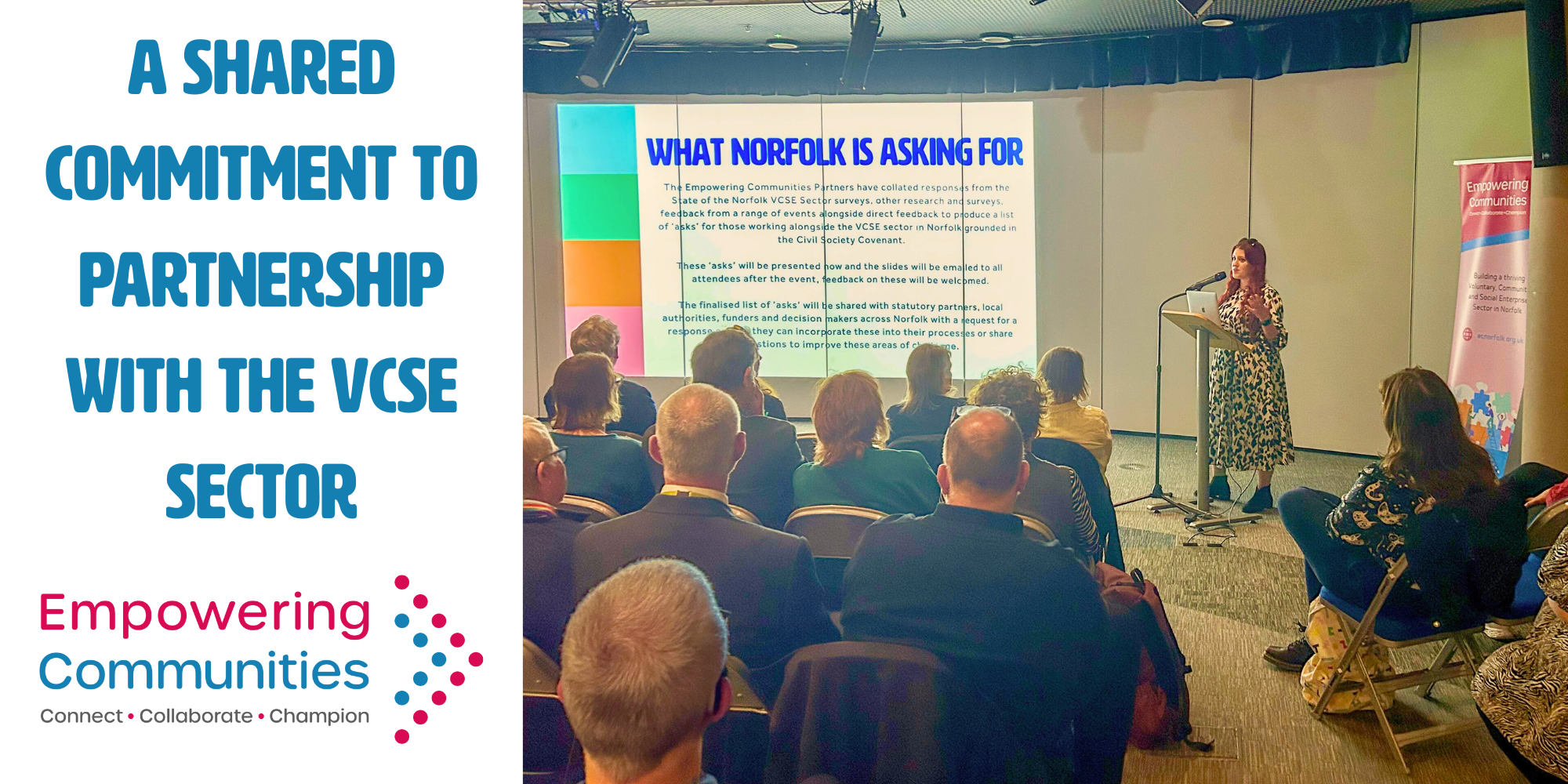
A Shared Commitment to Partnership with the VCSE Sector
As voluntary, community, and social enterprise (VCSE) organisations working across Norfolk, we are united in our commitment to the people and communities we serve. Every day, our sector delivers vital services, builds trust, unlocks potential, and responds to complex social challenges. We don’t do this work alone, but alongside local authorities, statutory partners, and others who share our commitment to making Norfolk a fairer, healthier, and more inclusive place.
We know that effective collaboration between sectors makes our county stronger. But to achieve this, we need the right conditions: trust, respect, shared responsibility, and meaningful partnership. That is why, together, we have developed and agreed on a clear set of sector-wide principles and asks.
These asks reflect what VCSE organisations across Norfolk say is needed to sustain our work, strengthen local systems, and improve outcomes for our communities. They have been shaped by organisations of different sizes, working in different ways, but with a shared voice and vision.
We are asking all public sector partners, commissioners, funders, and system leaders to listen and respond not just with words, but with practical steps to embed these asks into the way we work together.
What we’re asking for:
Value our contributions
Measure and publicly report the unpaid time VCSEs give to partnerships and systems development work and the outcomes these lead to.
VCSEs must have a seat at the table
Provide consistent and transparent VCSE representation in decision-making spaces, with equitable opportunities for involvement.
Invest in our infrastructure
Fund VCSE infrastructure to strengthen collective capacity and support measurement of the sector’s economic and social value in Norfolk.
Track VCSE spending
Report quarterly on all funding and spending with VCSEs to increase transparency, strengthen relationships, and highlight opportunities.
Unlock in-kind support
Share unused space, training, and resources to reduce overheads, foster collaboration, and support sector development.
Fair procurement
Simplify processes, offer smaller contract lots, support consortia bids, and invest in VCSE capacity to ensure equitable access.
Create one central platform
Develop a shared digital space to promote consultation and co-production opportunities across Norfolk, making it easier for communities and organisations to engage meaningfully.
Enable VCSE-led engagement
Resource VCSE organisations to design and lead participation activities, ensuring they are inclusive, accessible, and shaped by those closest to communities.
Clear, prompt payments
Publish grant and contract payment terms at the application stage and report regularly on performance against these. Timely payments are vital to VCSE sustainability, especially as reserves shrink.
Open decision-making
Share decision-making timelines upfront, communicate delays promptly, and provide regular updates. Transparency builds trust and enables continuity of service delivery.
Set clear expectations and provide feedback
Ensure reporting requirements are proportionate and clearly outlined from the outset so VCSEs can plan and resource them effectively. Provide feedback on submitted reports to close the loop, recognise our work, and support continuous improvement.
A Shared Commitment to the Covenant
We ask all partners to adopt and embed the principles of the Civil Society Covenant into our shared work. This is not just a framework, it is a call to act with fairness, equity, and shared responsibility for the communities we serve.
We call on you, our partners, to work with us to adopt and embed these principles in your policies, funding processes, decision-making structures, and everyday interactions with the VCSE sector. We know that some of this is already happening and we want to build on what works.
Together, we can ensure that the VCSE sector is not just included, but valued, resourced, and empowered as an equal partner in creating positive change in Norfolk.
Signed,
Willow Farrell
Director, FUSE Network
On behalf of the Empowering Communities Partnership
With thanks to Voluntary Norfolk for their contribution to the development of this letter and their ongoing collaboration as lead partner in the Empowering Communities Partnership.
Formal response: Norfolk Chambers of Commerce
In response to your open letter, published on 06 August 2025, we would like to confirm the continued support of Norfolk Chambers of Commerce in helping the VCSE sector better integrate across the wider Norfolk business community.
As a business membership organisation, we already offer an automatic 25% membership discount to any member who is a charity. We will often feature charities at our standard networking events, thereby giving them a platform to showcase their activities and to enable them to engage with the wider business community and stakeholders. Each Christmas, we run an online charity advent calendar – featuring all those charities within the Chambers membership. For our large-scale events, such as B2B (Business to Business) Exhibition, based off feedback, predominantly from the VSCE sector, we have created a market place type stand, smaller and more cost effective, thereby enabling those within that sector to showcase the amazing work that they are doing, but also giving them the opportunity to engage the commercial world, the larger corporates and potential fund raising opportunities.
As Chambers members, all our charities and CICs have full complimentary access to the Chambers’ website and social media channels – the average cost of featuring a news post, if run via an PR agency, is approx. £350 per post. Any charity or voluntary sector member can upload their content 24/7, 365 days per year at no charge as part of their Chambers membership. They can also upload and feature their events and activities on the Chambers events pages. Our marketing team stands ready to help support our members to communicate across our website and media channels. Norfolk Chambers digital reach is approx. 35,000. The whole of the Chambers team is highly customer centric and some are even volunteers for the likes of the Samaritans. The Chambers mission is to connect, support and give voice to every business in Norfolk – and we count the VCSE sector amongst that cohort. As an organisation, we provide the executive support for Charities United – supporting a whole range of charities, both member and non-member. We have also opened our Business Hub in the centre of Norwich for various community groups and supported them to launch their new ventures/projects, at preferential rates and often outside of business
hours.
The VCSE sector plays a huge role across the fabric of Norfolk and their impact cannot be underestimated. As a Chambers of Commerce, we are often asked to take an active part on multiple boards, steering groups and task and finish groups across the county – we will always flag the need for the voluntary sector to be part of these groups, as they are fundamental to the success of Norfolk as a whole. These include, the Neighbourhood Boards in Norwich, King’s Lynn and Great Yarmouth; the Employment & Skills Board, the HMP Norwich Employment Advisory Board and their Future Horizons Ex-offender initiative, to name just a few. Please be assured of our continued support for the VCSE sector.
Your sincerely,
Nova Fairbank
Chief Executive
Update – 2nd September 2025
Yesterday afternoon, the Empowering Communities Partnership sent the Open Letter on behalf of Norfolk’s VCSE sector to a wide range of statutory partners, funders and stakeholders across the county.
We have requested a response by Friday 17th October 2025 and will keep this platform updated with the responses we receive. We will also continue sending the letter to new partners and stakeholders as they are identified.
If you would like us to contact a funder, commissioner, or organisation you work with, please email [email protected] with their details.
The organisations contacted so far are:
-
Norfolk County Council
-
Norwich City Council
-
Breckland District Council
-
Broadland District Council
-
Great Yarmouth Borough Council
-
King’s Lynn & West Norfolk Borough Council
-
North Norfolk District Council
-
South Norfolk Council
-
Integrated Care System (Norfolk & Waveney ICS)
-
Integrated Care Partnership (ICP)
-
Norfolk & Norwich University Hospitals NHS Foundation Trust
-
Queen Elizabeth Hospital King’s Lynn NHS Foundation Trust
-
Norfolk & Suffolk NHS Foundation Trust
-
Norfolk Police & Crime Commissioner
-
Norfolk Constabulary
-
Department for Work and Pensions (DWP)
-
New Anglia Local Enterprise Partnership
-
Norfolk Chamber of Commerce
-
Norwich BID
-
Norfolk Community Foundation
-
Norwich Consolidated Charities
-
Aviva
We look forward to sharing further updates with you in due course.
Signed,
Willow Farrell, CEO, FUSE Network
Tasha Cobb, Empowering Communities Programme Manager, Voluntary Norfolk
On behalf of the Empowering Communities Partnership
Formal response: NHS Norfolk and Waveney Integrated Care Board
I am writing to you in response to the open letter.
The open letter has been shared with senior leadership of the ICB, including our Chief Executive and our Executive Director of Patients and Communities, who is currently the senior responsible officer for our VCSE partnering work programme.
We are keen to ensure a well-considered and meaningful response to the requests made in the letter and have been working to consider the appropriate actions for each of the points raised. We have scheduled a discussion with the ICB Board at its meeting in public on 26th November 2025 to consider the recommended actions, and we will then be in position to confirm our intended next steps.
I appreciate this does not quite meet the initial timeframes set out, but I hope that colleagues will agree it is important for discussions to take place at the most senior level to ensure there is organisational support for the actions we will take.
I will provide a formal response, via our executive team, following our Board meeting.
Best wishes
Shelley Ames
Head of Health Inequalities & VCSE Partnering
NHS Norfolk and Waveney Integrated Care Board
Formal response: Norfolk County Council
Thank you for your open letter and for bringing forward such a clear and collective voice on the issues that matter most to Norfolk’s communities. It is encouraging to see the sector come together with such purpose and shared commitment.
We welcome the opportunity to reflect on the asks you set out. Many of the issues raised have been acknowledged with our ongoing work, particularly proposals within our Local Government Reorganisation (LGR) submission. However, we recognise that while progress
is being made in some areas, there is still much more to do, and some of the challenges you’ve highlighted may benefit from earlier attention.
I have asked officers to provide me with a full briefing in this area so that we can fully consider our response to you, including identifying further steps we can take.
In the meantime, our commitment to working collaboratively with you remains. You will have seen that we recently committed to further funding for the Empowering Communities Partnership so that your important work to support the sector can continue.
Thank you again for your letter. We look forward to continuing this important conversation and will be in touch shortly with further updates.
Yours sincerely,
Cllr Kay Mason Billig
Leader of the Council
Formal response: Norwich City Council
We would like to thank the authors of the open letter for their thoughtful and constructive call to action.
Norwich City Council recognises the vital role that the VCSE sector plays in supporting our communities, particularly in times of challenge and change. We are proud of the city’s many charities, social enterprises and community organisations and the skills, expertise and passions which they bring to support the city and its residents. We have embedded working in partnership with these talented organisations and individuals over many years and we welcome this opportunity to reaffirm our commitment to working in genuine partnership with VCSE organisations across the city.
I have spoken with relevant officers across the organisation and have outlined below how we intend to respond to each of the asks you make in your letter.
Value our contributions
VCSE partners lend a significant amount of time and expertise to partnerships and systems development work in the city. These individuals and organisations bring years of experience and expertise which, put together with expertise from statutory partners and residents, helps us achieve better outcomes. We strongly support this
and we already publicly report, in a number of different places, where partners have been involved. This is in committee reports, on our website and in press releases.
VCSEs must have a seat at the table
We are very proud of our community-led plan. Central to that is VCSE representation in decision-making spaces alongside residents and other stakeholders. This happens across the organisation with daily partnership working, VCSE involvement in strategic partnerships, such as the Norwich Health and Wellbeing Partnership, and through
consultations. We will continue to carry out this work.
Invest in our infrastructure
We are committed to supporting VCSE infrastructure in the city and using the resources we have in an as effective way as possible. Our partnership with Norwich Unity Hub (NUH) is indicative of this where we have provided one of our largest assets to NUH on a three-year lease at a peppercorn rent so they can develop a physical VCSE hub. As part of this work, we are piloting an approach which will provide a social value measurement of the work being delivered at Carrow House. This approach uses figures published by HM Treasury and is likely to be able to be rolled out free of charge to other VCSE organisations in the city providing a free, efficient and effective option to measure the sector’s economic and social value.
Track VCSE spending
We currently report annually on the grant funding which we award to VCSEs, and we will continue to do so. These details can be viewed on the council website. Any grant funding opportunities are published widely and we make efforts to highlight opportunities to VCSEs who would be eligible to apply.
Unlock in-kind support
As above, we continue to look at ways we can use our assets to most effectively deliver the best social value for the city. Whilst Carrow House is the biggest example of this, there are a number of other spaces across the city which we provide at free or reduced rates to VCSE partners to help further their charitable aims and deliver
social value for the city. We continue to foster collaboration through these spaces as well as through the development of local networks which often help unlock peer to peer in-kind support.
Fair procurement
The National Procurement Policy Statement (NPPS), which came into effect on 24 February 2025, together with the Procurement Act 2023, places a strong emphasis on the inclusion of VCSEs in public procurement and we will ensure during our procurement exercises consideration is made to how we can, for example, simplify procurement processes or break the requirement into smaller lots. Also, our Contract Procedure Rules allow for smaller value contracts, below £25,000, to be awarded without competition and those between £25,000 and £100,000, to follow a three quotes exercise. Our commissioning contract managers are encouraged to consider
VCSEs and local, smaller organisations in their choices in these circumstances. We also welcome opportunities to engage with the VSCE community in respect of procurement and for example the council’s procurement team attended a Funding
the Future: Diversifying Income for Charities & Social Enterprises event in January 2025
Create one central platform
We manage and maintain a single digital platform for all consultation and engagement exercises run by the City Council. Get Talking Norwich is a citywide platform with interactive tools such as surveys and maps. Whilst it is predominantly used to host consultations being run by the City Council, we have recently hosted a consultation run by Cow Tower Dippers and we continue to be open to hosting
consultations for VCSE partners on projects for which we are a partner.
Norfolk is a big county, and we feel that having a central platform for the City is best for its residents, ensuring that information which is on there remains relevant to their lives.
Enable VCSE-led engagement
We recognise that VCSEs often have significant expertise and community trust which makes them well placed to design and lead participation activities. Where funding has been available in the past, we have resourced VCSEs to carry out these activities on our behalf including but not limited to budget consultations and community conversations. Where resources are not available to fund VCSE organisations to carry out this work, we work hard to ensure that communities can be involved in decision making on services which affect them in ways which are inclusive and accessible. This can be
through a variety of methods including but not limited to roadshows in public spaces across the city, stakeholder meetings, having community conversations in public spaces and on the doorstep, attending community meetings and activities.
Clear, prompt payments
Our Contract Procedure Rules require a maximum payment term for suppliers of 30 days however our standard payment terms are 20 days from date of invoice. This applies to both grant and contract payments.
Open decision-making
We try wherever possible to be clear on decision-making timelines upfront, provide regular updates and communicate delays. We will continue to do so. The council publishes a forward plan of its agenda and decisions on our website. Final decision notices are also published. Statutory deadlines are in place relating to key decisions
and the publication of papers in advance of meetings.
Set clear expectations and provide feedback
We are very conscious of ensuring reporting requirements are proportionate and that the requirement to report on public spending is balanced against not asking too much of VCSEs. In the interests of capacity building, we provide free support on how to evidence impact.
We will look to provide feedback on submitted reports to recognise your work and support continuous improvement. Communication about outcome and other achievements are developed in partnership with VCSE organisations.
A Shared Commitment to the Covenant
The City Council already embeds many of the principles of the Civil Society Covenant in our work. We recognise and value the VCSE sector, their expertise and perspectives; we seek to collaborate on work and develop partnerships wherever possible; we engage citizens in a variety of decisions about services which affect them and proactively remove barriers to participation and we engage in open
conversation with partners across the city.
We will continue to work to these principles and as local government reorganisation comes closer, we will seek opportunities for how the covenant could be incorporated into any new local authority covering Norwich.
Yours sincerely
Cllr Mike Stonard (He/Him)
Leader of the Council
Member for Catton Grove Ward
Norwich City Council
Formal Response: Office of the Police and Crime Commissioner for Norfolk
Thank you for your email of 2nd September. While this has been issued to my office rather than to me, I note that I am a recipient of the open letter that the letter references.
As a long-standing charity trustee and volunteer, all of the points raised in the letter resonate. I am aware of a distinct difference in approach that organisations have in Norfolk compared with other parts of the country with respect to local VCSEs, and in bringing more resource into our area’s charities, voluntary organisations and micro-businesses. For this reason, early this summer, I wrote the first Social Value Policy for any PCC in Norfolk. This is a simple policy at this stage, which will be used to secure social value aligned with the priorities in Norfolk’s Police and Crime Plan of preventing crime, cohesive communities, and reducing harm. The second version of the Social Value Policy is already in development and my intention is to launch this by the end of the year. This will bring the supply chain and our partners’ suppliers into scope and encourage and enable the provision of further opportunities and resources into Norfolk’s VCSEs. This revised Social Value Policy will also establish the infrastructure necessary for many of the points you raise such as recording VCSE spending, procurement and in-kind support.
More widely, you may be aware that through my commissioning role, I make a number of grant awards each year to provide support for victims of crime. This summer saw the first round of small grants to be awarded through the Police Property Act Fund and more will be released in early 2026. I understand the need for many VCSEs to have free funds to keep the lights on so that they can focus on their principal areas of work. For this reason, these small grants are principally focused on providing funding, which is not ring-fenced, to smaller VCSEs specifically in order to give opportunities for a more sustainable position to be developed.
While I am a strong supporter of, and advocate for, change for our VCSEs please be aware that my ability to drive this forward in earnest is hampered in practical terms by the unexpected shortness of my term and the arrangements for transition of my role into the new mayor’s role. At present, this means that there will be less resource available to support the roll out of initiatives such as those your open letter identifies e.g. sharing unused space and resources. For this reason, I am engaged with Norfolk Community Foundation to explore how they can support the implementation of some of the matters your open letter identifies such as the measurement of Social Value in Norfolk. I should add that, while I have a clear limit on the activity I can undertake, I am keen to support and help facilitate wherever possible in driving this forward as I believe that a strong VCSE network is vital to community cohesion and strength. Please do continue to engage with me (and my office where appropriate) in taking this forward.
Kind regards
Sarah Taylor (she/her)
The Police and Crime Commissioner for Norfolk
Formal response: Broadland District Council
We welcome the open letter and the opportunity it presents to reaffirm our shared commitment to partnership working with the Voluntary, Community and Social Enterprise (VCSE) sector across Norfolk. As a district council, we recognise the vital role the VCSE sector plays in supporting our communities, particularly those most in need, and we are proud of the strong relationships we have built with many of you.
Valuing Contributions
We fully acknowledge the significant unpaid time and expertise that VCSE organisations contribute to partnerships and systems development. While we recognise that measuring this input is complex and no single organisation holds all the data, we agree that greater visibility of these contributions is important. Members of our partnerships, including the Health and Wellbeing Partnership (HWP) and Community Links Network, give their time because they believe in the value of collaboration. As hosts of the HWP, we are not responsible for evaluating individual contributions, but we are committed to recognising and celebrating the collective outcomes these partnerships achieve.
Ensuring a Seat at the Table
We are committed to consistent and transparent VCSE representation in decision-making spaces. The HWP is open to all partners, and we are grateful for the active involvement of many VCSE signatories, including those who serve and have served as vice chairs of the partnerships in Broadland. Beyond the HWP, we appreciate VCSE input on specific projects, such as the Youth Advisory Boards, which have helped shape our support for young people. This has led to targeted Shared Prosperity Funding for organisations like YMCA and MTM Youth Services. It’s also worth noting that our elected Members, who shape council strategy, are themselves volunteers, underscoring the shared ethos of service that binds us.
Investing in Infrastructure
We support the call to strengthen VCSE infrastructure and recognise that this is best led by organisations with a system-wide footprint or through collaborative efforts within the sector. We encourage VCSE organisations to explore shared resources and collective savings to build resilience and capacity. Our community Links Network includes membership of around 230 grassroots and community-based organisations and volunteers across Broadland and South Norfolk, and we invest in supporting with developing new enterprises and initiatives, structure, access to funding, volunteering and marketing opportunities.
Tracking VCSE Spending
Transparency is key. We currently report annually on HWP spending and maintain a live webpage documenting Member-Led Grants and other funding streams. While some data is retrospective, we are working toward a live, regularly updated spreadsheet to improve visibility and accountability. We are open to increasing the frequency of reporting to quarterly where feasible and currently publish our financial performance on a quarterly basis into public facing council committees. In Broadland, in 24/25, we invested over £112k of grants in 96 VSCE organisations and groups.
Unlocking In-Kind Support
Through the Community Links Network, we provide a platform for VCSE organisations to share resources and collaborate. While financial constraints limit our ability to offer free space, we do provide reduced-cost access where possible and actively seek external funding to further subsidise these opportunities.
Fair Procurement
We are proud of our recent joint consortia bid with VCSE partners, which demonstrated the power of collective expertise. Feedback was overwhelmingly positive, and we hope our administrative support helped reduce the burden on smaller organisations. We are also revising HWP funding access to make it more inclusive and aligned with the Health and Wellbeing Strategy.
In addition, beyond the mandatory 80% business rates relief offered to all charities, Broadland District Council offers a further 20% (up to the value of £4k) of discretionary relief, depending on circumstances. Up to £12k can further discretionary relief can be applied for, for not-for-profit organisations.
Creating a Central Platform
We support the idea of a shared digital space for consultation and co-production and believe this is best led by organisations with a system-wide remit. Locally, we remain committed to co-producing services and will align with national initiatives such as the Government’s proposed online volunteering hub.
Enabling VCSE-Led Engagement
We continue to fund and support smaller VCSE organisations through various and dedicated grants that prioritise inclusivity, accessibility, and community-led design. These grants are a key tool for empowering grassroots action.
Clear, Prompt Payments
We strive to ensure our funding processes are clear and timely. While we do not currently offer large-scale funding, requiring ongoing performance measures, we are committed to transparency from the outset and to working within procurement legislation to ensure fairness and good governance.
Open Decision-Making
We are reviewing our communications to ensure funding applicants are aware of decision-making timelines. We also regularly review the HWP’s terms of reference to ensure they remain fit for purpose and support collaborative governance.
Clear Expectations and Feedback
The HWP encourages timely reporting and provides feedback through quarterly monitoring reviews. We are committed to proportionate reporting requirements and to recognising the value of the work our partners deliver.
A Shared Commitment to the Covenant
We are actively exploring how to embed the Civil Society Covenant into our working practices and welcome further dialogue with our local VCSE partners.
Let’s Continue the Conversation
We propose a dedicated Community Links Network meeting to explore these themes further and co-develop practical next steps. We believe that by working together, honestly, candidly, and as equals, we can continue to improve outcomes for our residents.
We recognise that no organisation or sector has all the answers, and that we all face significant financial and demand pressures. But our shared commitment to community wellbeing remains strong. Let’s build on what works and continue to evolve our partnership for the benefit of all.
Yours sincerely,
Jamie Sutterby
Director of People & Communities
Broadland District Council
Formal response: South Norfolk Council
We welcome the open letter and the opportunity it presents to reaffirm our shared commitment to partnership working with the Voluntary, Community and Social Enterprise (VCSE) sector across Norfolk. As a district council, we recognise the vital role the VCSE sector plays in supporting our communities, particularly those most in need, and we are proud of the strong relationships we have built with many of you.
Valuing Contributions
We fully acknowledge the significant unpaid time and expertise that VCSE organisations contribute to partnerships and systems development. While we recognise that measuring this input is complex and no single organisation holds all the data, we agree that greater visibility of these contributions is important. Members of our partnerships, including the Health and Wellbeing Partnership (HWP) and Community Links Network, give their time because they believe in the value of collaboration. As hosts of the HWP, we are not responsible for evaluating individual contributions, but we are committed to recognising and celebrating the collective outcomes these partnerships achieve.
Ensuring a Seat at the Table
We are committed to consistent and transparent VCSE representation in decision-making spaces. The HWP is open to all partners, and we are grateful for the active involvement of many VCSE signatories, including those who serve and have served as vice chairs of the partnerships in Broadland. Beyond the HWP, we appreciate VCSE input on specific projects, such as the Youth Advisory Boards, which have helped shape our support for young people. This has led to targeted Shared Prosperity Funding for organisations like YMCA and MTM Youth Services. It’s also worth noting that our elected Members, who shape council strategy, are themselves volunteers, underscoring the shared ethos of service that binds us.
Investing in Infrastructure
We support the call to strengthen VCSE infrastructure and recognise that this is best led by organisations with a system-wide footprint or through collaborative efforts within the sector. We encourage VCSE organisations to explore shared resources and collective savings to build resilience and capacity. Our community Links Network includes membership of around 230 grassroots and community-based organisations and volunteers across Broadland and South Norfolk, and we invest in supporting with developing new enterprises and initiatives, structure, access to funding, volunteering and marketing opportunities.
Tracking VCSE Spending
Transparency is key. We currently report annually on HWP spending and maintain a live webpage documenting Member-Led Grants and other funding streams. While some data is retrospective, we are working toward a live, regularly updated spreadsheet to improve visibility and accountability. We are open to increasing the frequency of reporting to quarterly where feasible and currently publish our financial performance on a quarterly basis into public facing council committees. In Broadland, in 24/25, we invested over £112k of grants in 96 VSCE organisations and groups.
Unlocking In-Kind Support
Through the Community Links Network, we provide a platform for VCSE organisations to share resources and collaborate. While financial constraints limit our ability to offer free space, we do provide reduced-cost access where possible and actively seek external funding to further subsidise these opportunities.
Fair Procurement
We are proud of our recent joint consortia bid with VCSE partners, which demonstrated the power of collective expertise. Feedback was overwhelmingly positive, and we hope our administrative support helped reduce the burden on smaller organisations. We are also revising HWP funding access to make it more inclusive and aligned with the Health and Wellbeing Strategy.
In addition, beyond the mandatory 80% business rates relief offered to all charities, Broadland District Council offers a further 20% (up to the value of £4k) of discretionary relief, depending on circumstances. Up to £12k can further discretionary relief can be applied for, for not-for-profit organisations.
Creating a Central Platform
We support the idea of a shared digital space for consultation and co-production and believe this is best led by organisations with a system-wide remit. Locally, we remain committed to co-producing services and will align with national initiatives such as the Government’s proposed online volunteering hub.
Enabling VCSE-Led Engagement
We continue to fund and support smaller VCSE organisations through various and dedicated grants that prioritise inclusivity, accessibility, and community-led design. These grants are a key tool for empowering grassroots action.
Clear, Prompt Payments
We strive to ensure our funding processes are clear and timely. While we do not currently offer large-scale funding, requiring ongoing performance measures, we are committed to transparency from the outset and to working within procurement legislation to ensure fairness and good governance.
Open Decision-Making
We are reviewing our communications to ensure funding applicants are aware of decision-making timelines. We also regularly review the HWP’s terms of reference to ensure they remain fit for purpose and support collaborative governance.
Clear Expectations and Feedback
The HWP encourages timely reporting and provides feedback through quarterly monitoring reviews. We are committed to proportionate reporting requirements and to recognising the value of the work our partners deliver.
A Shared Commitment to the Covenant
We are actively exploring how to embed the Civil Society Covenant into our working practices and welcome further dialogue with our local VCSE partners.
Let’s Continue the Conversation
We propose a dedicated Community Links Network meeting to explore these themes further and co-develop practical next steps. We believe that by working together, honestly, candidly, and as equals, we can continue to improve outcomes for our residents.
We recognise that no organisation or sector has all the answers, and that we all face significant financial and demand pressures. But our shared commitment to community wellbeing remains strong. Let’s build on what works and continue to evolve our partnership for the benefit of all.
Yours sincerely,
Jamie Sutterby
Director of People & Communities
South Norfolk Council
Formal response: Breckland Council
Please see below Breckland's response to the Open Letter:
Value our contributions - Measure and publicly report the unpaid time VCSEs give to partnerships and systems development work and the outcomes these lead to.
This is something we can certainly consider as part of our ongoing partnership work. However, it’s important to highlight that Breckland Council already recognises and values the vital role our VCSE partners play. We provide financial support for their time at Community Network Meetings, acknowledging that these meetings simply wouldn’t hold the same value without their involvement and expertise. We will continue to explore ways to recognise and evidence the broader contribution the VCSE sector makes to systems development and community outcomes.
VCSEs must have a seat at the table - Provide consistent and transparent VCSE representation in decision-making spaces, with equitable opportunities for involvement.
The VCSE sector has been a fundamental part of our Breckland Health and Wellbeing Partnership since its inception. We continue to actively engage with and listen to our VCSE colleagues to ensure their voices shape our priorities. Through our Inspiring Communities programme, we are proud to partner with VCSE organisations to deliver services that make a tangible difference for residents. The VCSE sector doesn’t just have a seat at the table in Breckland, it helps set the agenda.
Invest in our infrastructure - Fund VCSE infrastructure to strengthen collective capacity and support measurement of the sector’s economic and social value in Norfolk.
We have always sought to support and strengthen the VCSE sector across Breckland. This includes funding to help organisations cover operational costs and sustain delivery. We recognise that strong infrastructure underpins strong communities, and we will continue to explore opportunities to invest in the sector’s long-term capacity and resilience.
Track VCSE spending - Report quarterly on all funding and spending with VCSEs to increase transparency, strengthen relationships, and highlight opportunities.
This is something we already monitor through our Inspiring Communities match funding and the various other funding streams available to the voluntary sector. Transparency and accountability are central to how we operate, and we are always looking for ways to better demonstrate the positive outcomes achieved through these investments.
Unlock in-kind support - Share unused space, training, and resources to reduce overheads, foster collaboration, and support sector development.
We have consistently provided in-kind support to our VCSE partners, offering space in Council buildings such as Elizabeth House, Breck House, and, more recently, The Link. These spaces have become spaces that foster collaboration, reduce costs, and enable partnership working at the heart of our towns.
Fair procurement - Simplify processes, offer smaller contract lots, support consortia bids, and invest in VCSE capacity to ensure equitable access.
We regularly review our procurement processes to ensure fairness and proportionality. Our community grant funding operates on a tiered approach, ensuring requirements are appropriate to the level of funding awarded. Where we are delivering central government-funded programmes, we are required to meet specific national reporting standards, but we always strive to make these processes as straightforward and transparent as possible for our VCSE partners.
Create one central platform - Develop a shared digital space to promote consultation and co-production opportunities across Norfolk, making it easier for communities and organisations to engage meaningfully.
We would welcome a wider conversation about how such a shared platform could operate in practice and how Breckland Council could contribute to its development. We recognise the potential benefits of streamlining engagement and consultation across the county.
Enable VCSE-led engagement - Resource VCSE organisations to design and lead participation activities, ensuring they are inclusive, accessible, and shaped by those closest to communities.
This is an area we are particularly proud of. We already work hand in hand with VCSE organisations to lead engagement and deliver community-led initiatives. A great example is The Shelf Pop-Up Pantry, delivered in partnership with Citizens Advice Diss and Thetford and Norfolk Community Foundation demonstrating how VCSE leadership can create inclusive, locally owned solutions that improve lives.
Clear, prompt payments - Publish grant and contract payment terms at the application stage and report regularly on performance against these. Timely payments are vital to VCSE sustainability, especially as reserves shrink.
We understand how vital timely payments are for VCSE sustainability. We are committed to ensuring prompt and transparent payments to organisations and will continue to review our processes to ensure these remain efficient and reliable.
Open decision-making - Share decision-making timelines upfront, communicate delays promptly, and provide regular updates. Transparency builds trust and enables continuity of service delivery.
We will continue to share decision-making timelines with partners and ensure that communication around decisions remains open and transparent.
Set clear expectations and provide feedback - Ensure reporting requirements are proportionate and clearly outlined from the outset so VCSEs can plan and resource them effectively. Provide feedback on submitted reports to close the loop, recognise our work, and support continuous improvement.
We remain committed to keeping our reporting requirements clear and proportionate. Feedback is a vital part of continuous improvement, and we will continue to provide constructive responses on submitted reports, recognising the efforts of our partners and supporting shared learning.
A Shared Commitment to the Covenant - We ask all partners to adopt and embed the principles of the Civil Society Covenant into our shared work. This is not just a framework, it is a call to act with fairness, equity, and shared responsibility for the communities we serve.
We fully support the principles of the Civil Society Covenant. At Breckland Council, partnership, fairness, and shared responsibility are embedded in everything we do.
Kind regards,
Josh Fulcher
Communities and Health Integration Manager
Breckland Council
Formal response: Norfolk County Council
Norfolk County Council’s Response to the VCSE Sector Open
Letter
Norfolk County Council and the VCSE sector
Norfolk County Council works with the VCSE sector in a variety of interconnected ways. As a grant funder, the Council supports community-led initiatives that align with strategic priorities. As a commissioner, it partners with VCSE organisations to deliver essential services that meet local needs. As a strategic partner, the Council collaborates with the sector to shape policy, co-design solutions, and
strengthen community resilience. These roles are not separate silos but part of a dynamic and evolving relationship built on trust, shared purpose, and mutual accountability.
The value of the VCSE sector to Norfolk
Norfolk’s voluntary, community and social enterprise (VCSE) sector is a cornerstone of the county’s social fabric and a vital partner in delivering the Council’s ambitions for a fairer, greener, and more connected future. With an estimated 10,000 VCSE organisations operating across the county, including around 3,500 registered charities and social enterprises, the sector is deeply embedded in local communities and uniquely positioned to respond to their needs.
As an employer, the VCSE sector plays a significant role in Norfolk’s foundational economy. It supports thousands of paid staff and volunteers, offering meaningful employment and development opportunities, particularly in rural and underserved areas. The sector’s workforce is diverse and community-rooted, contributing to inclusive growth and skills development.
In terms of prevention, VCSE organisations are often the first responders to emerging social challenges. From foodbanks and mental health support to youth work and homelessness services, they deliver early interventions that reduce demand on statutory services and improve long-term outcomes. Their preventative work aligns closely with the Council’s goals around promoting independence, reducing inequalities, and supporting vulnerable residents.
The sector also plays a critical role in risk and resilience. During crises, from the COVID-19 pandemic to the cost-of-living pressures, VCSE organisations have mobilised rapidly to support communities, fill gaps, and maintain essential services. Their agility, local intelligence, and trusted relationships make them indispensable in emergency response and recovery planning.
Beyond service delivery, the VCSE sector contributes to civic life and democratic engagement. It amplifies community voices, fosters participation, and builds social capital. Through initiatives like the Empowering Communities Partnership, the sector has helped shape policy, co-design services, and strengthen the infrastructure that enables collaboration and innovation.
In short, the VCSE sector is not just a delivery partner, it is a strategic ally in achieving Norfolk County Council’s vision for thriving, resilient communities. Its contribution spans economic, social, and civic domains, and its continued strength is essential to the county’s future.
How we currently work with the sector
Norfolk County Council’s relationship with the VCSE sector is multifaceted and decentralised, reflecting the diversity of services and communities across the county. While there is no single model of engagement, the following structures and practices shape how the Council works with the sector:
Departmental relationships: Individual Council departments maintain their own relationships with VCSE organisations. These are often shaped by service specific needs, historical partnerships, and local delivery arrangements. This decentralised approach allows for tailored engagement but can lead to variation in practice and visibility across the organisation.
Commissioning and procurement: Departmental commissioners work with VCSE organisations to deliver services, following the Council’s Contract Standing Orders as set out in the Constitution. These rules are designed to ensure transparency, fairness and compliance with legislation, including the Procurement Act 2023. The Council uses the Government’s Find a Tender service to publish tenders and share pipeline notices, and designs its processes to reduce barriers for VCSEs and SMEs.
Grant funding Grants are managed at the service level, with each department responsible for its own grant programmes. This includes both strategic grants and small-scale funding.
Infrastructure and strategic link via the Communities Team: The
Communities Team provides a strategic link between the Council and the VCSE sector and engages with the sector on corporate issues, for example Devolution and Local Government Reorganisation.
VCSE Development and Engagement Officer: The Council has one full-time VCSE Development and Engagement Officer who acts as a single point of contact for the sector. This role coordinates infrastructure funding, supports cross-departmental collaboration, and facilitates communication between the Council and VCSE partners.
Partnership management: Where the Council manages formal partnerships (e.g. Empowering Communities), the responsibility for engaging with the VCSE sector sits with the partnership itself. This allows for more integrated and community-led approaches to engagement and delivery.
Consultation and Engagement: When consultation or engagement is required, it is the responsibility of the relevant service to lead the process. This includes designing engagement activities, gathering feedback, and ensuring that VCSE voices are reflected in service planning and decision-making.
Departmental VCSE Leads Group: A cross-departmental group of VCSE leads meets regularly to discuss strategic issues, share good practice, and coordinate action. This group plays a key role in shaping commissioning principles, grant strategies, and responses to sector feedback.
The Open Letter from the sector
In summer 2025, Norfolk’s voluntary, community and social enterprise (VCSE) sector came together to publish an open letter to statutory partners, including Norfolk County Council. This letter, developed collaboratively by organisations of all sizes and coordinated through the Empowering Communities Partnership, set out a series of clear and thoughtful asks aimed at improving how the whole of the
public sector works with the VCSE sector. These asks, to all public sector organisations, include calls for fairer procurement, prompt payments, investment in infrastructure, and a single digital space for engagement and consultation.
The letter reflects growing concern across the sector about rising costs, increasing demand, and the need for more consistent and equitable partnership working. Crucially, the sector is asking not just for words, but for meaningful action.
The Civil Society Covenant
One of the asks in the open letter is for Norfolk County Council to adopt and embed the principles of the Civil Society Covenant into our shared work.
The Civil Society Covenant is a principles-based framework launched by the UK Government on 17 July 2025 to reset and strengthen the relationship between government and civil society. Developed through extensive engagement with over 1,200 organisations, including charities, social enterprises, and local authorities, it recognises civil society as a trusted, independent partner in tackling complex societal challenges.
The Covenant sets out shared values and practical commitments to support collaboration, improve commissioning, and embed civil society in policy-making. It is designed to complement existing statutory and governance arrangements across the UK, and aims to foster more equal, transparent and impactful partnerships between government and the sector.
This paper is Norfolk County Council’s formal response to the open letter, setting out the work the Council already does, how the Council will address the issues raised and work with the sector to co-develop solutions that benefit Norfolk’s communities.
This report is structured under the principles in the Civil Society Covenant. Under each principle we address the relevant asks, set out what we are already doing in support and outline what further actions will take.
Recognition and value - Valuing civil society’s role
Invest in our infrastructure Fund VCSE infrastructure to strengthen collective capacity and support measurement of the sector’s economic and social value in Norfolk.
What we do now: Norfolk County Council has a long-standing commitment to funding VCSE infrastructure support, recognising its essential role in strengthening the sector’s collective capacity and amplifying its social and economic value.
Since 2021, the Council has funded and supported the Empowering
Communities Partnership (ECP), a collaborative programme delivered by Voluntary Norfolk, Community Action Norfolk, FUSE Network, and Norfolk Community Advice Network.
The ECP provides a joined-up infrastructure offer shaped by sector needs, including training, strategic forums, leadership development, and digital tools such as the Get InVOLved Norfolk volunteering portal and the Volunteering Passport.
The partnership has convened over 2,100 individuals from 563 organisations across 153 events, with 83 focused on capacity-building. It has also enabled sector-wide engagement in shaping public policy, including input into the Norfolk Economic Strategy and representation on the Norfolk Business Board. These successes demonstrate the value of sustained investment in infrastructure, and
further detail is available in the Empowering Communities Partnership Impact Report, included at Appendix B.
In addition to the Empowering Communities Partnership, Norfolk County Council has funded the Norfolk Community Advice Network Referral system for the past 04 years. The NCAN referral system is a secure digital platform that connects professionals with hundreds of advice and support organisations across Norfolk, enabling warm handovers and reducing barriers for residents in need. Norfolk
County Council funds it, as a core piece of infrastructure, because it underpins our priorities around tackling poverty and crisis, improves access to free, quality assured advice, and helps statutory services work efficiently with the VCSE sector to prevent issues from escalating.
What we are going to do: Norfolk County Council has recently reaffirmed its commitment to VCSE infrastructure by awarding a new grant to the Empowering Communities Partnership, extending funding through to March 2027. This funding supports a refreshed work plan developed in collaboration with the sector, which directly addresses several of the priorities outlined in the open letter. The plan focuses on strengthening leadership, improving access to volunteering, enhancing digital tools, and supporting inclusive engagement.
In addition to this core infrastructure investment, the Council is actively pursuing external funding opportunities to support infrastructure for social enterprise. The Norfolk Local Growth Plan advocates long-term funding streams for the sector and the need to reduce the costs of VCSE premises. Interventions such as these
will enable greater funds to be dedicated to enhancing the sector’s infrastructure.
Value our contributions Measure and publicly report the unpaid time VCSEs give to partnerships and systems development work and the outcomes these lead to.
What we do now: The Council recognises the importance of valuing the time, expertise and energy that VCSE organisations contribute to partnerships and systems development work. Measuring the unpaid time VCSE organisations contribute to partnerships helps show the real value of collaboration. It makes their role more visible, supports better service design, and strengthens the case for investment. For residents, it means more transparent decision-making and services shaped by community insight.
At present, there is no consistent approach across Norfolk, or nationally, to measuring or publicly reporting this contribution. The concept of “unpaid time” raises important questions: what should be measured, how should value be defined (in hours, financial terms, or outcomes), and whether a standardised approach is needed across all partnerships.
What we are going to do: In response, the Council proposes to initiate a conversation with the VCSE sector and public sector partners to explore what meaningful recognition could look like. This work has already been highlighted as a priority in the Norfolk Local Growth Plan’s Action Plan with a shared commitment to facilitate Social Impact workshops and collaboratively determine measures of value for the sector, a process that is likely to prioritise volunteering among a range of other measures We will also look to review approaches taken in other areas, identify existing good practice, and potentially pilot a method within a partnership setting. We will also consider how this could be embedded into any new partnership structures that emerge from the Local Government Reorganisation (LGR), ensuring that the sector’s contributions are visible, valued and inform future collaboration.
Partnership and collaboration - Building relationships
VCSEs must have a seat at the table Provide consistent and transparent VCSE representation in decision-making spaces, with equitable opportunities for involvement.
What we do now: Norfolk County Council recognises the importance of consistent and transparent VCSE representation in decision-making spaces. While formal decision-making is governed by the Council’s Constitution, VCSE organisations already play a vital role in shaping services and strategies through their involvement in numerous partnerships and working groups. A good example is the VCSE group that supports the work of the Norfolk Business Board. The Council is mindful of the sector’s capacity challenges and acknowledges that representation is often based on existing relationships, which may not always be equitable or inclusive. As part of the Local Government Reorganisation (LGR) proposals, the Council has committed to embedding VCSE voices into future governance structures, such as through Neighbourhood Area Committees and Integrated Neighbourhood Teams.
What we are going to do: Looking ahead, the Council will work with the sector to explore what fair and inclusive representation looks like, including how VCSE participants are identified and supported. This will help ensure that any new Unitary arrangements reflect the diversity and expertise of the sector and enable meaningful, community-rooted decision-making.
Fair procurement Simplify processes, offer smaller contract lots, support consortia bids, and invest in VCSE capacity to ensure equitable access.
What we do now: Norfolk County Council is committed to supporting equitable access to procurement for all organisations. The Council uses the In-Tend system, which offers a transparent audit trail and communication channel for all procurement activities. Guidance is available to help VCSEs and SMEs navigate the bidding process, and there is a stated commitment to delivering social value and climate benefits through procurement. Norfolk County Council makes use of several different models of procurement which can support VCSEs, in particular the smaller organisations to participate, including:
-
splitting larger contracts into Lots where it is practical and delivers best value for money
-
welcoming consortium bids
-
requiring bidders for our largest contracts to set out how they will
encourage local sub-contractors
-hosting market engagement events at an early stage in developing commissioning plans and gathering feedback.
As part of the Local Growth Plan, we heard that general understanding within the VCSE sector around the goods and services we buy as well as how we do it was low. In addition, building sector capacity was identified as a key priority for all parties, recognising that it benefits the public sector to have skilled and informed delivery partners, and enables the VCSE sector to deliver high-quality services for Norfolk’s communities.
What we are going to do: Building on our existing transparent procurement processes, the Council is committed to listening to and understanding the challenges faced by some VCSE groups in accessing opportunities. We will work with the sector to build a clearer understanding of how we buy services, identify any barriers, and explore how processes might be simplified in the future or adapted as we move towards a new unitary structure. Our aim is to ensure that learning from this engagement informs future improvements, while continuing to support equitable access.
We will also continue to work with colleagues to deliver the priority actions under the Local Growth Plan.
Unlock in-kind support Share unused space, training, and resources to reduce overheads, foster collaboration, and support sector development.
What we do now: Norfolk County Council is committed to making the best use of its assets such as spaces, equipment, expertise and training opportunities by working collaboratively with the VCSE sector to serve our communities. Examples of this collaboration have included support with technology and IT kit, supporting a successful funding bid for the Volunteering for Health Fund which led to the new Volunteering Skills website, and sharing event car parking arrangements for the Unity Hub at Carrow House. These contributions reflect a practical, collaborative spirit rather than a structured programme.
What we are going to do: Where possible, we will continue to share resources with VCSE partners, not as an end in itself, but as a means of enabling organisations that are closest to our residents to deliver positive outcomes. This approach ensures that Council assets are used strategically and responsively, supporting the delivery of our objectives and meeting community needs in partnership with those best placed to reach and support Norfolk’s diverse communities.
Looking ahead, the Council is planning to open up selected training courses to VCSE organisations through a new training website, as well as aspiring to launch a County Council and VCSE mentoring system, where managers from the public sector are matched with their counterparts in social enterprises and VCSEs. This initiative will create opportunities for reciprocal learning, foster greater understanding of each sector’s challenges and strengths, and build the foundations for more effective, joined-up working.
Participation and inclusion - Empowering communities
Create one central platform: Develop a shared digital space for consultation and co-production.
What we do now: Norfolk County Council understands the VCSE sector’s frustration with the fragmented nature of consultation and co-production opportunities. At present, there is no single digital space for engagement, and organisations often receive separate communications from multiple public sector partners.
While there is no centralised platform, the Council has supported sector-wide communication through the Empowering Communities Partnership, which shares news and opportunities with VCSE organisations. Past good practice in Norfolk included a shared online hub for consultations, but re-establishing this would require cross-sector commitment and ownership, something that is challenging during the current Local Government Reorganisation (LGR).
What we are going to do: Instead, the Council will work with infrastructure partners to explore a “test and learn” approach, such as creating a shared engagement and consultation page or padlet on the Empowering Communities Partnership website. This would highlight opportunities and link through to relevant consultations, helping reduce duplication and improve access.
Enable VCSE-led engagement - Resource VCSE organisations to design and lead participation activities, ensuring they are inclusive, accessible, and shaped by those closest to communities.
What we do now: Norfolk County Council recognises that VCSE organisations are often best placed to engage with communities, particularly those who may be underrepresented or are seldom heard. The Council already works with VCSE partners to support inclusive engagement, and acknowledges that this work must be properly resourced. However, engagement approaches vary across services,
and requests to the sector are not always given sufficient notice, or allow time for co-production to take place.
What we are going to do: As Norfolk moves towards Unitary arrangements, it will be increasingly important for the Council/s to build their own relationships with communities while continuing to work with VCSE organisations as trusted intermediaries. In response to this ask, the Council will initiate a conversation with the sector and partners to explore what VCSE-led engagement could look like in practice, identify where it is already working well, and consider how future partnership structures can embed and resource this approach more consistently.
Transparency and data - Strengthening trust and accountability
Track VCSE spending: Report quarterly on funding and spending with VCSEs.
What we do now: Norfolk County Council is committed to transparency in its funding and already publishes monthly reports of all grants and contracts over £500, including the names of recipient organisations. However, while this data is publicly available, we currently cannot reliably identify which organisations are VCSEs. This is due to technical limitations in our systems and the complexity of
defining VCSE status.
What we are going to do: We’ve started addressing this by adding a VCSE field to our supplier records, and we’re working to populate it for new and updated entries. Although it’s not yet possible to report VCSE-specific spending, this is firmly on our radar and will be a priority as we move towards any future Unitary arrangements. Rather than retrofitting historic data, our focus is on building a robust and consistent approach going forward, so that VCSE spending can be tracked, reported and used to inform better decision-making.
Clear, prompt payments: Publish grant and contract payment terms at the application stage and report regularly on performance against these. Timely payments are vital to VCSE sustainability, especially as reserves shrink.
What we do now: The Council complies with the legal requirement for 30 day payment terms in its contracts and outlines its payment process clearly: suppliers must submit invoices with the correct details to avoid delays. Payments are made via BACS, and remittance advice is provided by email. Some 96% of payments are made on time and we publish our performance. The Council acknowledges that timely payments are vital to VCSE sustainability.
What we are going to do: We will listen to the sector to better understand any challenges around payment timing, particularly whether issues relate to the scheduling of payment milestones within contracts or grants, rather than the payment process itself. While the Council is strongly committed and legally obliged to make payments within 30 days of receiving a valid invoice, we recognise that the timing of payments (for example, whether they are made at the start, mid-point, or end of delivery) can impact VCSE sustainability. We will
use this feedback to inform future approaches and ensure our processes support the sector as effectively as possible whilst protecting public money.
Open decision-making: Share decision-making timelines upfront, communicate delays promptly, and provide regular updates. Transparency builds trust and enables continuity of service delivery.
What we do now: Transparency is a core principle of Norfolk’s procurement process. The Council publishes a Contracts and Grants Register quarterly, in line with the Local Government Transparency Code. Feedback is provided after each tender, including full details of scores and reasons for scoring. The procurement strategy and contract standing orders (see Constitution Part 7.8) outline formal commitments to openness. However, decision-making timelines and updates during contract delivery could be more consistently communicated.
What we are going to do: We will ask the VCSE sector for specific examples where decision-making timelines or updates have not been clear. This will help us target improvements. We’ll work with commissioning and contract management teams to highlight the impact of unclear communication, and update our internal guidance so staff provide timely updates and communicate changes promptly. By working together with the sector and our teams, we aim to make open decision-making the norm.
Set clear expectations and provide feedback: Ensure reporting requirements are proportionate and clearly outlined from the outset so VCSEs can plan and resource them effectively. Provide feedback on submitted reports to close the loop, recognise our work, and support continuous improvement.
What we do now: The Council provides feedback after tenders and assigns a contract manager as the first point of contact for any issues. However, there is room to improve clarity around reporting requirements and responsiveness to support VCSE organisations in planning and resourcing their work effectively.
What we are going to do: We’ll ask VCSE partners for specific examples where our reporting requirements or feedback haven’t worked well. This will help us identify and address the main issues. Using this insight, we’ll update our guidance and work with contract managers and commissioners to make reporting clearer and feedback more consistent. By learning from the sector and improving our own processes, we aim to support better planning and continuous improvement.
The responses to the last three asks above are given from the perspective of commissioners. However, it’s equally important that we apply these principles to how we award grants. At present, Norfolk County Council does not have a standardised set of principles for grant giving. Work is underway to develop best practice guidelines for grant funding across the council, which will support greater consistency. This work will also help to inform and strengthen any new
arrangements that may emerge from the creation of a new unitary authority or authorities.
Additional note:
Discussion of this response at a Cabinet meeting can be viewed here, time stamp 56 minutes: youtube.com/watch?v=LnT7C6hjjJc&list=PLeRpx16K8zO4...
You're invited - Turning Asks into Action: Norfolk VCSE & Statutory Partners Event
You're invited to attend a collaborative, solutions-focussed event to shape the next steps from this open letter to Norfolk's statutory partners.
FUSE Network and Voluntary Norfolk sent this letter to local statutory partners and funders on behalf of the Empowering Communities Partnership and the wider sector last year. We had a number of detailed responses, many of which committed to making changes to processes, policies and ways of working with local VCSEs. Real progress has been made in the last year and it's key to keep that momentum going.
Join us for a collaborative, solutions-focussed session bringing together VCSEs, statutory sector colleagues and stakeholders to:
-
Hear an update on progress made against the asks so far
-
Work together on practical next steps for key priority areas
-
Strengthen relationships and shared understanding across sectors
-
Keep the momentum moving as Norfolk faces a period of change
This is designed to be a working session, not a talking shop and we want you to help shape what happens next.
Tuesday 20th October 2026, 1.30pm-4.30pm @ The Kings Centre, King Street, Norwich
Booking is essential:
eventbrite.co.uk/e/turning-asks-into-action-norfol...
Email [email protected] with any questions.
- Willow Farrell, CEO, FUSE Network, Norwich
- Catherine Gray, CEO, Cup-O-T: Wellness and Therapy Services, Wymondham
- charlotte Evans, Operations Manager, Family Action, Norfolk
- Michael Kitching, CEO, Voluntary Norfolk, Norwich
- Amy Griffiths, CEO, Citizens Advice Diss, Thetford & District, Diss
- Matthew Talbot, CEO, Deaf Connexions, Norwich
- Abby Erwin, Manager, Community Chaplaincy Norfolk, Norwich
- Ann Donkin, Chief Executive, Age UK Norfolk (previously Age Concern Norfolk), Norfolk
- Chrissie Nebbett, Administration and Operations, Plug the Gap, Norwich
- Sophie Wood, Director, Back in the Groove CIC
- Nicky Stainton, Head of VCSE Sector Support, Voluntary Norfolk, Norwich
- Steve Wiseman, Director, Norwich Eco Hub, Norwich
- Fiona Gosden, CEO, TimeNorfolk, NORWICH
- Nicky Turner, Director, HubL Norwich, Norwich
- Rik Martin, CEO, Community Action Norfolk, Dereham
- Ben Scarlett, Director, Norfolk Community Advice Network, Norwich
- Rebecca White, Consultant, Hasler-White Inclusive Facilitation, Norwich
- Tamara Rampley, Designer, STAND Ethical Fashion
- James Kearns, CEO, The BUILD Charity, Norwich
- Gemma Harvey-O'Connell, CEO, The Feed, Norwich
77 more
verified signatures
- Judeline Nicholas, Learning and Development Consultant, jna, Mundesly
- Mary Ledgard, Chair, Norfolk Older People's Strategic Partnership
- Les Rowlands, Chair, Norfolk Neighbourhood Watch, Norwich
- Tracey Drake, Head of Place, Business in the Community, Norwich
- Rachel Cowdry, CEO, Break, Norwich
- John Lee, CEO, YMCA Norfolk, Norwich
- Louise Gardiner, CEO, Action Community Enterprises CIC, Great Yarmouth
- Roger Bilton-Hill, Project Manager, Stepping Stones Project, Norwich
- Kirsty Pitcher, CEO, The Benjamin Foundation, Norwich
- Katherine Severson, Director, Tend Collective Community Interest Company, Norwich
- Sarah Harvey, Director Operations, Caring Together Charity, St Ives Cambridgeshire
- Sophie Little, Co-Production & Project Officer, Carers Voice Norfolk and Waveney, Norwich
- Sharon Brooks, Chief Officer, Carers Voice Norfolk and Waveney, Norfolk & Waveney
- Richard Felton, Director, Felton Fundraising, Dereham
- Peter Hill, Chair: Wymondham Archers, Norwich, Norfolk
- Joshua Fulcher, Communities and Health Integration Manager, Breckland, Norfolk
- Sam Brown, Star Throwers Cancer Support Charity, Norwich
- Tracy Kenny, CEO, Kett's Books, Wymondham
- Laura Blackwell, Co-creator and Manager, Gifted Norwich, Norwich
- Claire Atherton, Creative Health & Equity Lead, Cultural Health & Wellbeing Alliance, Norfolk/Suffolk
and sign it together